Mergers & Acquisitions

Rocket Lab - Iridium: Why Space M&A Is Moving Toward Vertical Integration
July 5, 2026
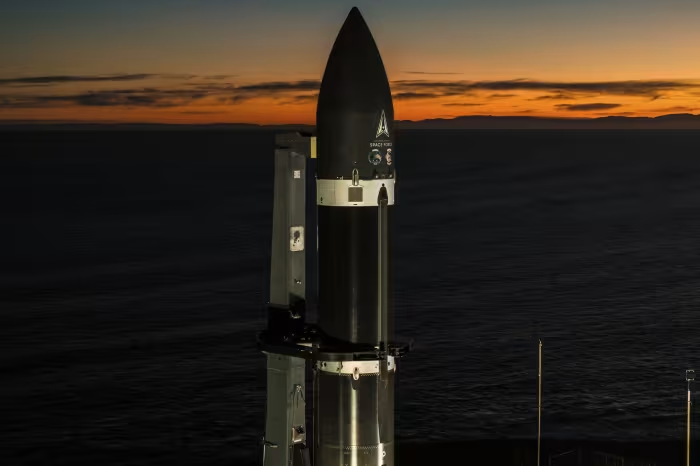
Rocket Lab’s $8B acquisition of Iridium gives it more than a satellite network. It gives Rocket Lab spectrum, subscribers and a services layer that would be difficult to build from scratch, making the deal a clear bet on vertical integration in space.

When Rocket Lab agreed to acquire Iridium for approximately $8.0 billion, it was not simply adding another space asset to its portfolio. The transaction gives Rocket Lab access to Iridium’s global satellite communications network, globally coordinated L-band spectrum, more than 2.55 million active subscribers and a partner ecosystem of over 500 companies. Under the announced terms, Rocket Lab will acquire Iridium for $54 per share in a cash-and-stock transaction, with closing expected in mid-2027, subject to shareholder and regulatory approvals.

The appeal of Iridium is that it gives Rocket Lab a services layer that would be difficult to build organically. Rocket Lab is already present in launch and space systems, while Iridium brings the network, spectrum and customer base that sit closer to the end user. Rocket Lab’s own announcement says the combined company would be able to design, build, launch and operate space-based communications infrastructure, which is why the transaction is being positioned as a step toward a more vertically integrated space business.

For a company historically associated with launch, the acquisition also changes the shape of Rocket Lab’s revenue base. Iridium generated $871.7 million of revenue and $495 million of operational EBITDA in 2025, implying a 57% operational EBITDA margin. That matters because satellite-services revenue is typically more recurring than launch activity, and it gives Rocket Lab a larger cash-flow base from which to fund future network, spacecraft and launch investments.

One of the most important assets in the deal is not a satellite, but spectrum. Iridium’s globally harmonized L-band spectrum supports communications across government, defense, aviation, maritime and commercial markets. Spectrum is a regulated and scarce communications asset, so Rocket Lab is acquiring a layer of the value chain that cannot be replicated quickly by building more rockets or satellites alone.

The commercial logic becomes clearer when the downstream opportunity is considered. Rocket Lab says the combined company will pursue areas such as direct-to-device connectivity, satellite IoT, positioning, navigation and timing services, and safety-of-life communications. These are end-market applications, not only infrastructure capabilities, which suggests Rocket Lab wants to move closer to the customer problems that satellite networks solve rather than remain mainly an upstream supplier of launch and spacecraft capacity.

The transaction structure also shows the scale of the commitment. Iridium shareholders will receive $27 in cash and Rocket Lab shares, with a combined notional value of $54 per share, representing a roughly 24% premium to Iridium’s last closing price before the announcement. Reuters also reported that Rocket Lab has secured a $3.6 billion bridge loan from Deutsche Bank and Wells Fargo to help fund the cash component of the deal.

Execution risk remains meaningful because Rocket Lab is not only buying assets, it is expanding into a larger and more complex operating model. The deal still requires shareholder and regulatory approvals, and Rocket Lab’s own disclosure flags risks around financing, integration, business disruption, expected benefits and customer relationships. Those risks are standard in a large transaction, but they matter here because Rocket Lab would be combining launch, spacecraft manufacturing, satellite operations, regulated spectrum and customer-facing communications services inside one business.

The larger M&A insight is that space companies are starting to pay for control of scarce layers in the value chain. Launch remains important, but it does not capture the full economics of space-based communications if the network, spectrum, customer relationship and recurring revenue sit elsewhere. Rocket Lab’s move for Iridium is a way to bring those layers closer together and reduce its dependence on only one part of the market.

For the space sector, the deal is a reminder that vertical integration is becoming a practical strategy rather than just a positioning statement. Building rockets is valuable, but owning the network, spectrum and customer base attached to those rockets can be more powerful. Rocket Lab–Iridium is therefore best read as a transaction about control: control over launch, control over the satellite network, and control over the customer-facing services that turn space infrastructure into recurring revenue.
Credits

No items found.
Author:
Dhruv Sabharwal
Published:
05 Jul 2026

Rocket Lab - Iridium: Why Space M&A Is Moving Toward Vertical Integration

Rocket Lab’s $8B acquisition of Iridium gives it more than a satellite network. It gives Rocket Lab spectrum, subscribers and a services layer that would be difficult to build from scratch, making the deal a clear bet on vertical integration in space.
Mergers & Acquisitions

When Rocket Lab agreed to acquire Iridium for approximately $8.0 billion, it was not simply adding another space asset to its portfolio. The transaction gives Rocket Lab access to Iridium’s global satellite communications network, globally coordinated L-band spectrum, more than 2.55 million active subscribers and a partner ecosystem of over 500 companies. Under the announced terms, Rocket Lab will acquire Iridium for $54 per share in a cash-and-stock transaction, with closing expected in mid-2027, subject to shareholder and regulatory approvals.

The appeal of Iridium is that it gives Rocket Lab a services layer that would be difficult to build organically. Rocket Lab is already present in launch and space systems, while Iridium brings the network, spectrum and customer base that sit closer to the end user. Rocket Lab’s own announcement says the combined company would be able to design, build, launch and operate space-based communications infrastructure, which is why the transaction is being positioned as a step toward a more vertically integrated space business.

For a company historically associated with launch, the acquisition also changes the shape of Rocket Lab’s revenue base. Iridium generated $871.7 million of revenue and $495 million of operational EBITDA in 2025, implying a 57% operational EBITDA margin. That matters because satellite-services revenue is typically more recurring than launch activity, and it gives Rocket Lab a larger cash-flow base from which to fund future network, spacecraft and launch investments.

One of the most important assets in the deal is not a satellite, but spectrum. Iridium’s globally harmonized L-band spectrum supports communications across government, defense, aviation, maritime and commercial markets. Spectrum is a regulated and scarce communications asset, so Rocket Lab is acquiring a layer of the value chain that cannot be replicated quickly by building more rockets or satellites alone.

The commercial logic becomes clearer when the downstream opportunity is considered. Rocket Lab says the combined company will pursue areas such as direct-to-device connectivity, satellite IoT, positioning, navigation and timing services, and safety-of-life communications. These are end-market applications, not only infrastructure capabilities, which suggests Rocket Lab wants to move closer to the customer problems that satellite networks solve rather than remain mainly an upstream supplier of launch and spacecraft capacity.

The transaction structure also shows the scale of the commitment. Iridium shareholders will receive $27 in cash and Rocket Lab shares, with a combined notional value of $54 per share, representing a roughly 24% premium to Iridium’s last closing price before the announcement. Reuters also reported that Rocket Lab has secured a $3.6 billion bridge loan from Deutsche Bank and Wells Fargo to help fund the cash component of the deal.

Execution risk remains meaningful because Rocket Lab is not only buying assets, it is expanding into a larger and more complex operating model. The deal still requires shareholder and regulatory approvals, and Rocket Lab’s own disclosure flags risks around financing, integration, business disruption, expected benefits and customer relationships. Those risks are standard in a large transaction, but they matter here because Rocket Lab would be combining launch, spacecraft manufacturing, satellite operations, regulated spectrum and customer-facing communications services inside one business.

The larger M&A insight is that space companies are starting to pay for control of scarce layers in the value chain. Launch remains important, but it does not capture the full economics of space-based communications if the network, spectrum, customer relationship and recurring revenue sit elsewhere. Rocket Lab’s move for Iridium is a way to bring those layers closer together and reduce its dependence on only one part of the market.

For the space sector, the deal is a reminder that vertical integration is becoming a practical strategy rather than just a positioning statement. Building rockets is valuable, but owning the network, spectrum and customer base attached to those rockets can be more powerful. Rocket Lab–Iridium is therefore best read as a transaction about control: control over launch, control over the satellite network, and control over the customer-facing services that turn space infrastructure into recurring revenue.
Read more from us

Jul 20, 2026
Industry Insights

Europe’s Chemicals Sector Is Facing a Structural Reset

Dhruv Sabharwal
Jul 12, 2026
Strategic Analysis

AI Capex Is Becoming the New Competitive Moat

Dhruv Sabharwal
Jun 27, 2026
Industry Insights

Water Is Becoming the Next Infrastructure Constraint

Dhruv Sabharwal