The AI conversation has often been framed around model quality, product launches and talent density, but that lens is no longer sufficient. As generative AI moves from experimentation into large-scale deployment, the companies best positioned to compete are not only those with strong models, but also those that can finance, build and operate the infrastructure those models require. Reuters reported that Amazon, Microsoft, Alphabet and Meta are expected to spend around $600 billion on AI-related investment in 2026, a level of spending that has made investors increasingly focused on whether the eventual returns can justify the scale of capital being deployed.
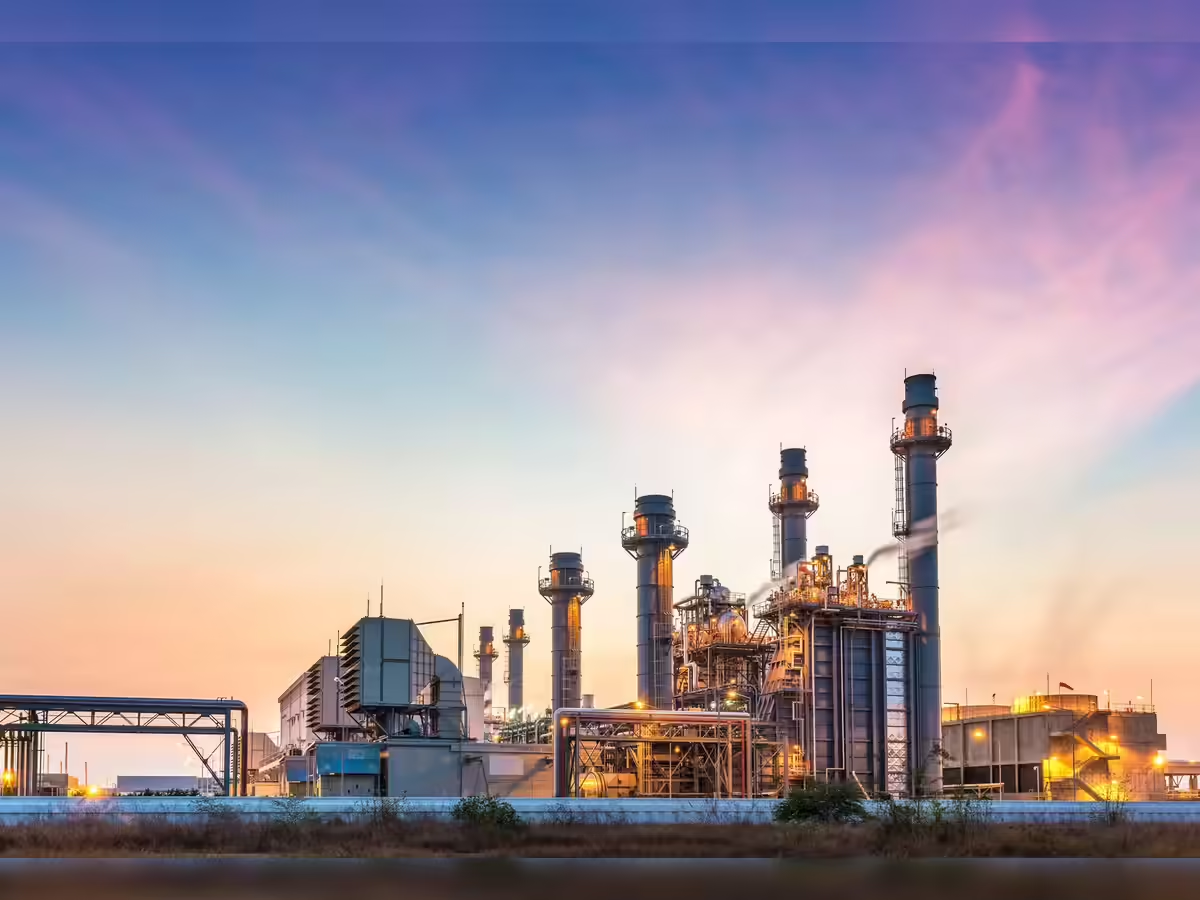
The reason this spending matters is that AI does not scale like a traditional software business. Large AI systems need advanced chips, servers, data centers, high-speed networking, cooling systems and access to reliable power, which turns infrastructure into a strategic input rather than a back-office cost. The IEA estimates that global data-center electricity consumption could more than double to around 945 TWh by 2030, representing just under 3% of total global electricity consumption in its base case. That kind of demand growth means AI capacity is becoming tied to physical constraints such as grid availability, energy procurement and construction timelines.
The numbers at the company level show how concentrated this race is becoming. Alphabet said it was targeting $175 billion to $185 billion of capital expenditure in 2026, with Reuters reporting that AI computing capacity, servers, data centers and networking equipment were central to the plan. Amazon projected about $200 billion of capex in 2026, up from $131 billion in 2025, as it continues to invest heavily in AWS and AI infrastructure. These are not normal technology investment cycles; they look more like industrial build-outs, where access to capital, suppliers, construction capacity and power becomes part of competitive advantage.
In that context, capex starts to behave like a moat. A smaller AI company can still build a strong model or application, but it is difficult to match the infrastructure position of a hyperscaler that already has cloud customers, procurement scale, owned data-center capacity, engineering depth and a balance sheet large enough to fund multi-year build-outs. This does not mean that spending alone guarantees success; the better interpretation is that infrastructure depth raises the threshold required to compete at full scale, particularly when customers want reliability, enterprise-grade deployment and integration with existing cloud environments. This is an inference from the reported scale and nature of hyperscaler investment, rather than a claim that capex by itself creates defensible returns.
The physical nature of the AI build-out is also changing how investors should think about the sector. In software, growth has often been associated with high margins and relatively limited incremental capital intensity. AI infrastructure is different because the next unit of demand may require real-world capacity: another data hall, another cluster of GPUs, another power connection or another long-term energy contract. The IEA notes that data centers can often be built in two to three years, while electricity infrastructure generally requires longer planning and development cycles, which creates a mismatch between digital demand and the pace at which energy systems can respond.
The return question is therefore becoming more important than the spending headline. Reuters reported that Amazon’s 2026 capex outlook raised investor concerns, with Wall Street increasingly looking for evidence that AI spending will translate into operational or financial returns. The same broader concern applies across Big Tech: companies can justify heavy investment if it leads to higher cloud revenue, better advertising performance, enterprise AI adoption or productivity gains, but the market is becoming less willing to treat capex as automatically value-accretive simply because it is AI-related.
There is also a strategic risk in the fact that several large companies are building aggressively at the same time. If AI demand continues to grow rapidly and customers are willing to pay for premium capacity, the companies with the deepest infrastructure bases may be rewarded. If utilization is weaker, pricing falls, or model efficiency reduces the need for incremental compute, some of today’s investment could earn lower returns than expected. The key point is not that the AI build-out is necessarily overbuilt, but that the economics will depend on utilization, pricing power and the ability to attach infrastructure spend to monetizable products.
For strategy, the implication is that AI competition is moving from a model-only debate to a system-level contest. The companies that win will still need strong models and compelling products, but they will also need the financial capacity to build infrastructure, the operating capability to deploy it, the customer base to absorb it and the discipline to avoid capacity that cannot be monetized. Capex is becoming a serious strategic signal because it shows who is willing and able to fund the physical layer of AI, but it is also becoming a test of execution because infrastructure only becomes a moat when it is converted into durable customer demand and returns.